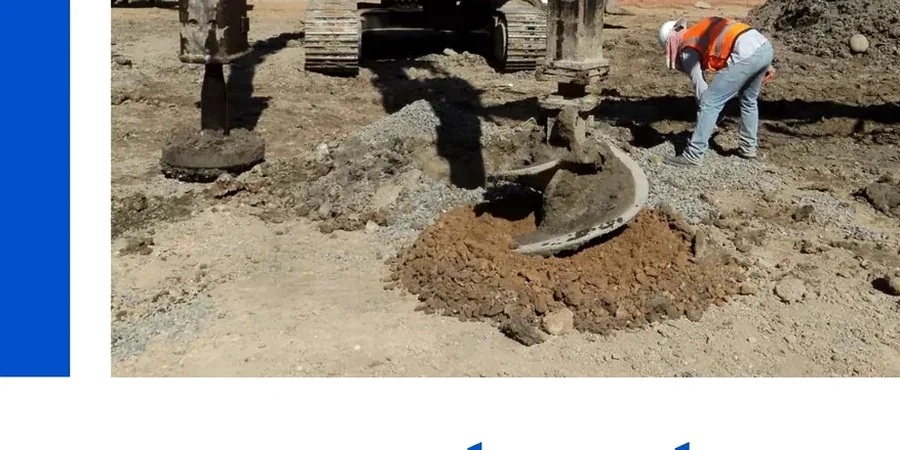
The vibratory probe sinks into the ground with a low, steady hum, displacing the saturated soil laterally as the first load of clean stone drops from the hopper. In London Ontario, where the glacial Lake Warren deposits left behind layers of soft clay and silt extending dozens of meters below the surface, this is often the most reliable way to build on poor ground. The design of these stone columns requires a careful balance between aggregate gradation, column spacing, and the undrained shear strength of the surrounding native material. We see it regularly on sites near the Thames River floodplain, where the water table sits just a meter or two below grade. A well-designed column network transforms a marginal site into a buildable platform, without the cost and carbon footprint of a full deep foundation. The process integrates field data from CPT testing to profile the soft zones and confirm that the soil is displaceable, and we cross-check those results with laboratory grain size analysis to confirm the aggregate meets the filter criteria against the surrounding fines.
In London's soft post-glacial clays, a stone column grid with 15 percent area replacement typically cuts settlement by half while doubling the bearing capacity of the untreated soil.
Our approach and scope
Site-specific factors
The National Building Code of Canada references CSA A23.3 and the Canadian Foundation Engineering Manual as the basis for foundation design, and in London Ontario, the consequence of underestimating column settlement can mean costly remedial work or structural distress within the first five years. The primary risk lies in zones where the clay contains organic lenses or fibrous peat: these materials do not carry out the lateral confinement needed for column formation and can lead to excessive bulging or even column failure at depth. A second risk is poor drainage design: stone columns accelerate consolidation, but if the expelled pore water has nowhere to go, excess pressure builds up beneath the slab. We mitigate this by specifying drainage blankets and verifying with post-installation CPT soundings at a rate of at least one test per 20 columns. Knowing the Thames River's seasonal fluctuations is key; a design that works in August must still function during the March thaw when the ground is fully saturated and the water table peaks.
Reference standards
National Building Code of Canada (NBCC) – Division B, Part 4, CSA A23.3 – Design of Concrete Structures (load transfer platform compatibility), Canadian Foundation Engineering Manual (CFEM) – 4th Edition, ASTM D448 – Standard Classification for Sizes of Aggregate
Other technical services
Feasibility and preliminary design
We review geotechnical data, run column interaction analyses using Priebe or finite element methods, and deliver a concept report with grid layouts and settlement estimates tailored to London's subsurface conditions.
Detailed design and construction oversight
Full design package including column diameter, spacing, depth, aggregate specification, and load transfer platform details. We supervise the trial column installation and adjust the design based on real-time installation data and verification testing.
Typical parameters
Quick answers
What does stone column design cost for a typical project in London?
Engineering design fees for a stone column ground improvement package in London Ontario generally range from CA$1,940 for a straightforward, single-structure site with existing geotechnical data, up to CA$6,850 for a complex multi-building development requiring finite element modeling, multiple column interaction analyses, and full construction-phase oversight.
How deep can stone columns be installed in London's soil?
With vibro-replacement methods, columns typically reach depths of 6 to 15 meters in London's soft clay and silt deposits. The practical limit is governed by the ability of the vibrator to penetrate and by the presence of dense till or bedrock, which in the London area often lies 20 to 35 meters below the surface depending on the location relative to the buried St. David's Gorge.
Can stone columns prevent liquefaction in London's sandy layers?
Stone columns do carry out a densification and drainage benefit in loose, saturated sands, but true liquefaction hazard is relatively low in London's core clay zones. Where interbedded sandy layers exist, we combine column design with a site-specific seismic assessment per NBCC, and columns act as both reinforcement and vertical drains to dissipate excess pore pressure during cyclic loading.
What verification testing do you specify after column installation?
We specify a program of post-installation CPT soundings through the column center and between columns to confirm density improvement, along with zone load tests or individual plate load tests on selected columns. The acceptance criteria are tied directly to the design settlement and bearing capacity targets.