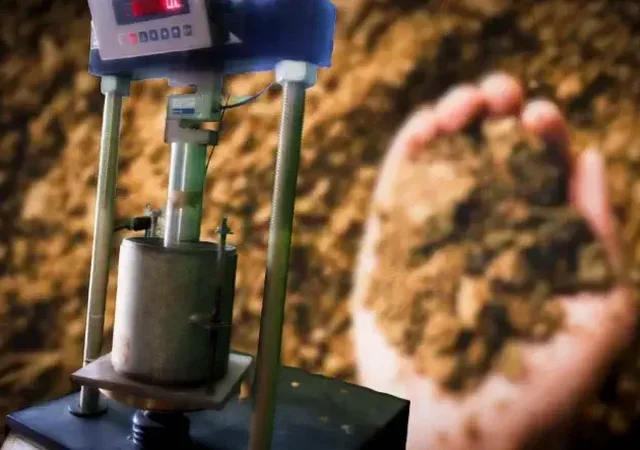
One of the most common mistakes we see in London projects is accepting subgrade material based on a grain-size curve alone, without verifying its strength under saturated conditions. A well-graded sand can turn to mush after a spring thaw if its CBR drops below 3%. That is where the laboratory CBR test becomes non-negotiable. Our team runs the procedure under ASTM D1883, using a mechanical compactor to prepare the specimen at the optimum moisture content from a standard Proctor, then soaking it for 96 hours to simulate the worst field conditions London’s freeze-thaw cycles can produce. The result is a CBR number that feeds directly into the AASHTO 1993 pavement design equation, or into the mechanistic-empirical methods Ontario’s MTO now favours. For projects near the Thames River floodplain — where silty clays over glacio-lacustrine deposits are common — we often pair the soaked CBR with a grain-size analysis to confirm fines content before committing to a lime or cement stabilization strategy.
A soaked CBR value under 3% signals that the subgrade cannot support construction traffic without a working platform — a hard lesson learned on many London-area jobsites.
Our approach and scope
- Specimen preparation at modified or standard Proctor energy per ASTM D1557/D698
- 96-hour soak with swell measurement dial gauges reading to 0.001 inch
- Penetration piston at 0.05 in/min with load ring calibrated to 10 lbf resolution
- Correction for concave upward curves per ASTM D1883 Section 8.4
Site-specific factors
With a population approaching 430,000 and growing, London’s residential subdivisions are pushing into areas where the surficial geology transitions from the Norfolk sand plain into the St. Joseph’s till moraine. These silty tills have a nasty reputation: they compact well at 2% over optimum but lose 60% of their strength after a single wet-dry cycle. A CBR test run without the 96-hour soak — or worse, a field DCP test performed in August when the water table is low — will overpredict the subgrade support by a factor of two or more. The consequence shows up two winters later as alligator cracking in the asphalt, often concentrated in the wheel paths of the first 50 metres from an intersection, where braking forces are highest. Ontario’s MERO-030 guideline explicitly requires soaked laboratory CBR values for flexible pavement design, and the City of London’s development engineering manual references the same requirement for subdivision roads. Skipping the soak, or running the test on a single specimen instead of the full three-point compaction curve, leaves the pavement structure vulnerable to differential heave and premature fatigue cracking.
Reference standards
ASTM D1883-21 — Standard Test Method for California Bearing Ratio (CBR) of Laboratory-Compacted Soils, ASTM D698-12(2021) — Standard Test Methods for Laboratory Compaction Characteristics of Soil Using Standard Effort, ASTM D1557-12(2021) — Standard Test Methods for Laboratory Compaction Characteristics of Soil Using Modified Effort, CSA A23.3:19 — Design of Concrete Structures (referenced for rigid pavement subgrade modulus correlation), MTO MERO-030 — Ontario Ministry of Transportation Pavement Design and Rehabilitation Manual
Other technical services
Soaked CBR with Swell Potential
Full 96-hour submersion with continuous swell monitoring via dial gauge; reported at 0.1-inch and 0.2-inch penetration with correction for concave curves.
Three-Point Compaction CBR Curve
CBR determined at 10, 25, and 56 blows per layer to produce the strength-vs-density envelope, used to verify the 95% modified Proctor compaction specification.
CBR-SPT Correlation for London Tills
Site-specific correlation development between field SPT N-values and laboratory CBR for the Port Stanley and St. Joseph's till formations common to the London area.
Pavement Structure Verification
Combined CBR, grain-size, and Atterberg limits package for MTO-compliant flexible pavement design, including granular A and B thickness calculations.
Typical parameters
Quick answers
How much does a laboratory CBR test cost in London, Ontario?
A single-point soaked CBR test, including Proctor compaction to determine optimum moisture, runs between CA$170 and CA$260 depending on whether you need the standard or modified Proctor energy. A full three-point CBR curve — testing at three compaction levels to generate the strength-vs-density relationship — typically falls in the CA$500 to CA$700 range for a complete set.
Do I need the soaked CBR or can I run it unsoaked for a parking lot?
Even for a private parking lot in London, we strongly recommend the soaked CBR. The freeze-thaw cycles here saturate the subgrade every spring, and an unsoaked CBR overpredicts strength. The City of London development manual references MTO MERO-030, which explicitly requires soaked values for any flexible pavement design. The extra 96 hours of soak time is far cheaper than a pavement that fails after two winters.
Can you correlate my field DCP readings to a laboratory CBR value for our London site?
We can, but with an important caveat. The DCP-CBR correlation is soil-type dependent, and the silty tills common across London — especially the St. Joseph's till — produce correlations that differ from the standard literature. We recommend running at least three side-by-side DCP and laboratory CBR tests on your specific subgrade to generate a site-specific correlation curve. Using a generic correlation without local calibration is the most common source of pavement under-design we encounter in the region.