In London, we often see foundation designs that underestimate just how variable the local glacial till can be across a single lot. The city sits on a complex mix of silty clay till, sand lenses, and weathered shale of the Kettle Point Formation, which means two boreholes fifty metres apart can show completely different bearing capacities. A proper soil mechanics study here goes well beyond standard blow counts—it quantifies undrained shear strength, consolidation parameters, and seasonal groundwater fluctuation tied to the Thames River watershed. We integrate these findings with in-situ permeability testing when basement dewatering is anticipated, and we rely on triaxial consolidated-undrained tests to model effective stress conditions beneath heavily loaded footings on the saturated silt layers common north of Oxford Street.
London’s glacial till can vary from stiff crust to soft silt in less than three metres—treating it as uniform is the most expensive shortcut a project can take.
Our approach and scope
Site-specific factors
London’s residential expansion into the former agricultural lands south of Commissioners Road has placed new subdivisions directly atop thick sequences of compressible lacustrine silts that were never intended for structural loads. Historically, the area served as the lakebed of glacial Lake Whittlesey, leaving behind rhythmically bedded silts and clays that can consolidate unevenly under fill. The risk manifests as differential settlement, cracking partition walls, and sloping floors within the first five years of occupancy. A rigorous soil mechanics study in London must identify these varved deposits early, because once the framing is up, remediation through grouting or stone-columns becomes exponentially more expensive and disruptive than the upfront investigation cost.
Video resource
Reference standards
NBCC 2020 (National Building Code of Canada), CSA A23.3:19 Design of Concrete Structures, ASTM D4767 Triaxial Compression Test, ASTM D2435 One-Dimensional Consolidation, Ontario Regulation 332/12 Building Code
Other technical services
Foundation Engineering Analysis
We evaluate bearing capacity and settlement for spread footings, mat foundations, and pile groups using laboratory-derived strength and consolidation parameters. Each analysis accounts for the seasonal groundwater table variations documented by the Upper Thames River Conservation Authority.
Slope Stability and Excavation Support
For sites along the Thames Valley slopes or near the Medway Creek ravine, we perform limit equilibrium analyses using measured effective stress parameters. Our reports include recommendations for temporary cut slopes and permanent retaining structures compliant with Ontario Building Code requirements.
Typical parameters
Quick answers
What does a soil mechanics study include for a residential build in London?
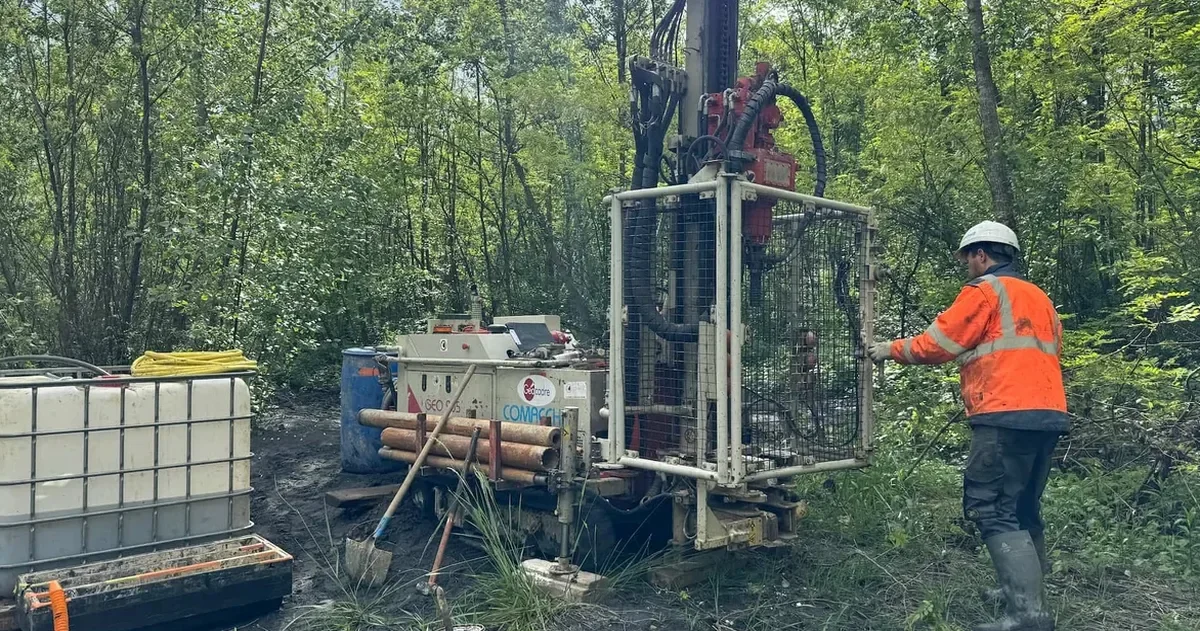
For residential projects, the scope typically starts with a borehole program reaching five to eight metres depth, depending on the proximity to the Thames River or known sand lenses. We recover undisturbed Shelby tube samples at foundation elevation and run a suite of lab tests: natural moisture content, Atterberg limits, unconfined compression on the clay till, and one-dimensional consolidation if the proposed footing loads suggest settlement will govern. The report provides ultimate and allowable bearing pressures with a factor of safety consistent with NBCC 2020 and CSA A23.3, plus recommendations for any required granular fill bridging over soft zones.
How much should I budget for a soil mechanics study in London Ontario?
For a typical single-lot residential study in London, including drilling, lab testing, and the engineering report, you can expect costs in the range of CA$4,070 to CA$6,480. The final figure depends on the number of boreholes, the depth required, and whether specialized testing like triaxial shear or consolidation is needed based on the soil conditions encountered.
How does the Kettle Point shale bedrock affect foundation design in London?
In parts of west London and toward Byron, the Kettle Point Formation—a black, organic-rich shale—can be encountered within six to ten metres of grade. While it provides excellent end-bearing for deep foundations, it weathers rapidly when exposed to air and water. Our studies include point load testing on recovered shale core to assess durability, and we specify construction sequencing that limits open excavation time if the shale will form the bearing surface.
What is the difference between a soil mechanics study and a standard geotechnical report?
A soil mechanics study is the analytical core within a geotechnical report. While a standard report may focus on borehole logs and descriptive classifications, the soil mechanics component quantifies engineering properties—shear strength parameters, compressibility indices, hydraulic conductivity—through controlled laboratory testing. This data is essential for modelling settlement, slope stability, and retaining wall design in London’s layered till deposits.