London's growth from a mid-19th century administrative outpost into a sprawling regional hub didn't happen on uniform ground. The city stretches across a mix of glacial till plains, silty clay deposits, and ancient river terraces carved by the Thames. Every new low-rise in White Oaks or mid-rise near Western University sits atop a subsurface that demands more than a desktop study. The Standard Penetration Test (SPT) remains the most direct way to get that picture. By driving a split-spoon sampler into the ground and recording the blow counts, we translate resistance into N-values that local geotechnical engineers rely on for bearing capacity and settlement predictions. In a city where the water table can be just a couple of meters down in parts of the old floodplain, skipping this step is a gamble no experienced builder in London, Ontario, is willing to take anymore. Pairing field data with a triaxial shear test in the lab gives you the full stress-strain behavior of the silty clay layers common east of Adelaide Street.
An N-value of 50 in London's glacial till is not the same as 50 in loose sand. Local geology always trumps the textbook correlation.
Our approach and scope
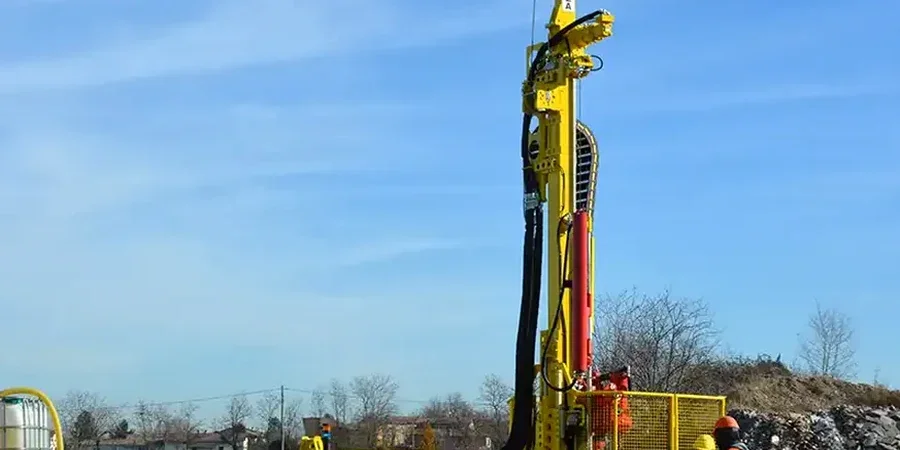
Site-specific factors
The freeze-thaw cycle in southwestern Ontario punishes shallow foundations in ways that coastal cities never expertise. London sits in a humid continental climate zone, where frost can penetrate over a meter deep in an exposed open field. If your SPT data only goes to three meters and you're designing a footing at 1.2 meters, you're missing the frost-susceptibility story entirely. Silty soils with high capillary action heave in January and soften into a soupy mess by March. We correlate SPT N-values with grain size distribution from a grain size analysis to flag frost-susceptible layers before they become a call-back. The other risk is seismic — while London is in a moderate seismic zone under the NBCC 2020, loose saturated sands along the Thames River could be prone to cyclic mobility. A low blow count in a sandy layer below the water table is a red flag that demands a closer look at liquefaction potential.
Reference standards
ASTM D1586 - Standard Test Method for SPT and Split-Barrel Sampling of Soils, CSA A23.3 - Design of Concrete Structures (foundation provisions), NBCC 2020 - National Building Code of Canada (seismic site classification via N-value), Canadian Foundation Engineering Manual (CFEM) 4th Edition
Other technical services
SPT for Shallow Foundations
We target the top 6 to 10 meters for spread footings and slab-on-grade. N-values and sample descriptions feed directly into bearing capacity equations per CFEM guidelines.
Deep Borehole SPT for Pile Design
For mid-rise structures, we go 20 to 30 meters or until refusal on bedrock. The data helps determine pile toe elevation and skin friction in the dense till.
Combined SPT and Groundwater Monitoring
We install observation wells in the borehole to track seasonal water table fluctuations, critical for basement excavations in London's silty plains.
Typical parameters
Quick answers
What does an SPT test cost in London, Ontario?
For a typical residential or light commercial investigation in London, you're looking at a range of CA$740 to CA$1,050 per borehole, which usually covers drilling to 10 meters with SPT sampling at the standard 1.5-meter intervals. The final figure depends on access, the number of boreholes, and whether we hit refusal on a dense till layer. Mobilization of the drill rig and traffic control permits, especially on tighter lots in Old South, are separate line items. It's a modest upfront cost compared to the liability of under-designed footings.
How many boreholes do I need for my project in London?
The Ontario Building Code and the local geotechnical engineer's scope of work will dictate the number, but a good rule of thumb for a single-family home on a standard London lot is two to three boreholes. For a commercial building on a larger footprint, we typically space them on a 15 to 25 meter grid. The key is capturing variability — the Thames River flats can surprise you with a pocket of peat or loose silt between two stiff clay boreholes.
How long does it take to get the SPT report after drilling?
You'll have the field logs with raw N-values and soil descriptions the same day the drill rig demobilizes. The final geotechnical report, which includes bearing capacity calculations, settlement estimates, and seismic site classification per NBCC Table 4.1.8.4.A, typically follows within 5 to 7 business days. If you need it faster for a construction loan deadline, we can expedite the lab testing and reporting.
Can SPT testing be done in winter in London?
Absolutely. We drill year-round in London, Ontario. Frozen ground actually works to our advantage on soft, wet sites — the frost crust provides a stable working platform for the drill rig. We use a heated water tank to prevent the drilling fluid from freezing in the rods. The only slowdown is during an active heavy snowfall when the City's plows haven't cleared the access roads, but that's rare.