The glacial history of Southwestern Ontario left London with a complex stratigraphy that makes permeability assessment anything but routine. Glacial till, interbedded silts, and fractured limestone of the Dundee Formation all respond differently to water movement—and guessing wrong leads straight to construction delays or groundwater management failures. Our field permeability testing program applies the Lefranc method in soil and the Lugeon method in rock, following CSA A23.3 and ASTM D4630 protocols to quantify hydraulic conductivity where it matters most: in the formation itself. For deeper projects near the Thames Valley corridor, where artesian conditions occasionally appear, combining these tests with a CPT investigation helps delineate confining layers before excavation reaches critical depth.
A single Lugeon value without pressure-stage analysis is just a number—five stages reveal whether the rock dilates, washes out, or accepts grout predictably.
Our approach and scope
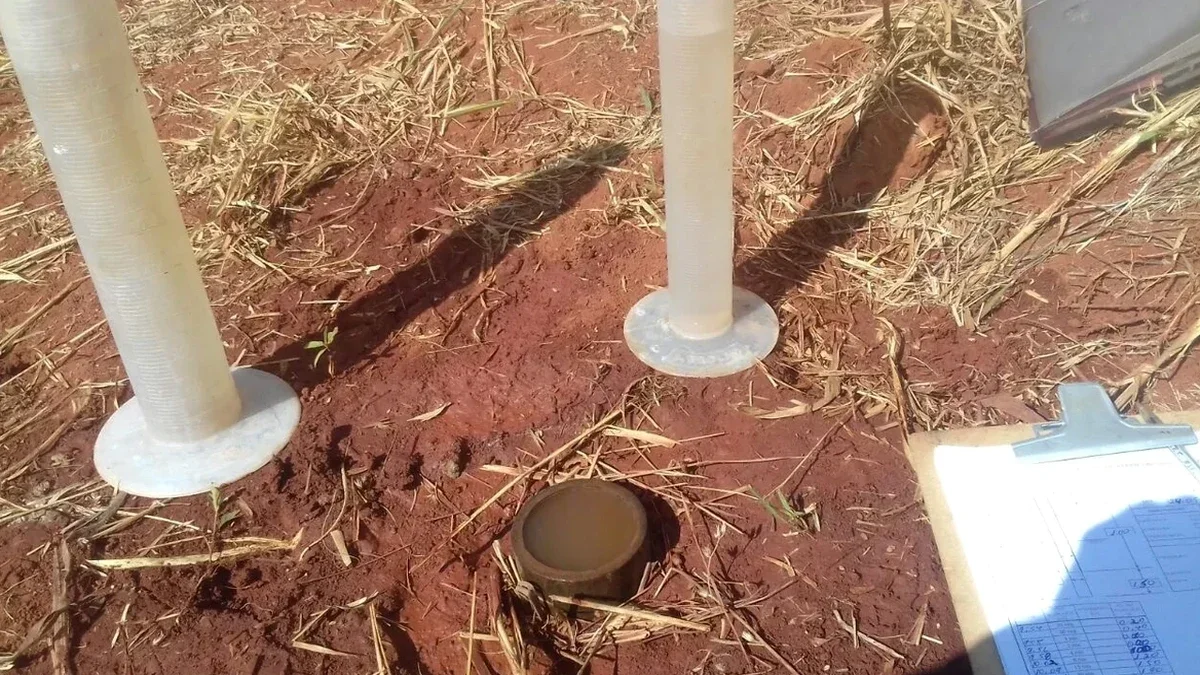
Site-specific factors
London sits at roughly 251 m elevation on a paleo-lake plain where groundwater flows southwest toward the Thames River and its tributary creeks. The city's 2023 climate resilience strategy flagged basement flooding as a recurring risk in older neighborhoods like Old South and Blackfriars—risk that is magnified when infill development proceeds without verifying that surrounding soils can transmit water away from new foundations. An untested assumption of 'impermeable till' has led to more than one temporary shoring failure when perched water appeared at 3 m depth in what the borehole log called a dry hole. Proper Lefranc testing across the full depth of proposed excavation reveals those lenses before the excavator does. For deep infrastructure near the river, we incorporate findings into a slope stability analysis to ensure that elevated pore pressures are factored into the factor of safety for any cut or retaining structure.
Reference standards
CSA A23.3-14: Design of Concrete Structures (reference for groundwater evaluation), ASTM D4630-19: Standard Test Method for Determining Transmissivity and Storage Coefficient, Ontario Building Code (O.Reg. 332/12) – Part 4, Section 4.2.4 (Groundwater Control), Houlsby, A.C. (1976) – Routine interpretation of the Lugeon water-test, CSA A23.1/A23.2 – Concrete Materials and Methods of Construction (grouting references)
Other technical services
Lefranc Variable-Head Tests in Overburden
Performed in cased boreholes at depths specified by the geotechnical investigation plan. Each test records time-drawdown data for at least three head differentials; results are reduced to an equivalent isotropic k-value using the Hvorslev shape factor for the intake geometry. Suitable for silty sands, tills, and clayey silts across London's till plain.
Lugeon Packer Tests in Bedrock
Single or double-packer assemblies isolate discrete intervals in NQ or HQ coreholes. Five 10-minute pressure stages per interval—typically at 0.25, 0.50, 0.75, 1.0, and 0.5 MPa—allow classification of hydraulic behavior (laminar, turbulent, dilation, washout, or impermeable). Results guide grout curtain design for excavations intersecting the Dundee or Lucas formations.
Typical parameters
Quick answers
What is the difference between a Lefranc test and a Lugeon test?
The Lefranc test measures permeability in soil or very weak rock over a screened interval open to the borehole wall, typically using falling or constant head methods. The Lugeon test is designed specifically for fractured rock: a pneumatic packer isolates a discrete section of the borehole, and water is injected at five increasing then decreasing pressure stages. The resulting Lugeon value (1 Lu ≈ 1.3 × 10⁻⁵ cm/s) and the shape of the pressure-flow curve reveal whether fractures dilate, erode, or remain stable under pressure.
How much does field permeability testing cost in London Ontario?
For a typical investigation in the London area, budget between CA$860 and CA$1,540 per test interval. The final figure depends on depth, whether a single or double packer is required, and how many pressure stages are specified. Mobilization to sites in Middlesex County and the need for traffic control on arterial roads like Oxford Street or Wellington Road can also influence the total.
How many Lugeon test intervals do I need for my London project?
The number depends on the depth of excavation into bedrock and the fracture density observed in core logs. A general rule is one test per 3 to 5 m of competent rock, with additional intervals placed at zones of high fracture frequency, RQD drop, or where water inflow was noted during drilling. For a 10 m deep excavation into limestone, three to four intervals often carry out adequate coverage to satisfy Ontario Building Code groundwater control requirements.