The St. Joseph's till plain underlying much of London, Ontario presents a consistent challenge for earth retention: a stiff to hard silty clay matrix interspersed with discontinuous sand lenses. Groundwater perched on these lenses can destabilize a cut face within hours of excavation. A retaining wall design here cannot rely on textbook assumptions. Our team correlates high-quality Shelby tube samples with in-situ permeability testing to map these water-bearing layers before a single earth pressure coefficient is selected. For deeper profiles where the till transitions into the underlying Dundee Formation limestone, we often recommend CPT testing to define the bedrock surface with precision, avoiding costly over-excavation or unexpected refusals during pile installation.
In London's till, a retaining wall is only as reliable as the characterization of its perched groundwater. We prioritize pore pressure measurement over assumed drained parameters.
Our approach and scope
Site-specific factors
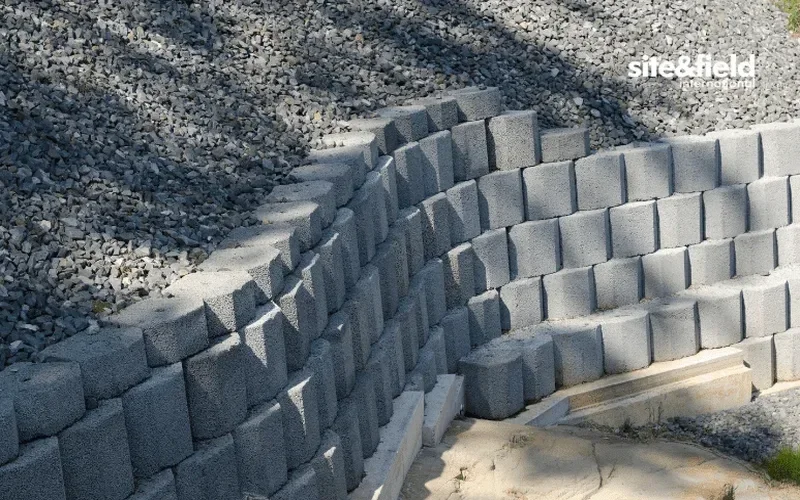
A common observation on London construction sites is the rapid deterioration of unsupported trench walls in the weathered till zone after a heavy rain. The upper 1.5 to 2.0 meters of the soil profile is often fractured and oxidized, exhibiting a much lower suction than the intact till below. Ignoring this weathered crust in the design leads to surficial sloughing that undermines the wall's backfill. One project near the Medway Creek ravine saw a segmental block wall lean forward by 80 mm during a single spring thaw because the designer assumed a homogeneous soil profile. We mitigate this by specifying a granular chimney drain wrapped in non-woven geotextile directly behind the wall stem, sized to handle the design storm intensity for a 1-in-50-year event, and by checking external stability under both drained and undrained end-of-construction conditions.
Video resource
Reference standards
NBCC 2020 (National Building Code of Canada), CSA A23.3-19 (Design of Concrete Structures), CSA S6-19 (Canadian Highway Bridge Design Code, Earth Retaining Structures), ASTM D4767 (Consolidated Undrained Triaxial Compression Test)
Other technical services
Geotechnical Investigation for Retaining Walls
A targeted subsurface program including hollow-stem auger drilling to recover undisturbed till samples, installation of standpipe piezometers to monitor seasonal groundwater fluctuations, and laboratory determination of drained and undrained strength parameters. The resulting report provides the factored soil parameters, seismic site class per NBCC Table 4.1.8.4.A, and lateral earth pressure diagrams for the specific wall configuration.
Structural Design and Stability Analysis
Detailed design of cantilever, gravity, or mechanically stabilized earth walls. We perform overturning, sliding, and bearing capacity checks using limit states design principles from the CHBDC (CSA S6-19). The package includes reinforcement detailing, joint layout plans, and a global stability model using Spencer's method to satisfy the 1.5 factor of safety required by the local conservation authority for walls adjacent to watercourses.
Typical parameters
Quick answers
What is the typical cost range for a retaining wall design in London, Ontario?
Engineering fees for a retaining wall design typically range from CA$1,230 to CA$5,770, depending on the wall's height, complexity, and the extent of the required geotechnical investigation. A simple gravity wall under 1.2 m may be at the lower end, while a cantilevered wall over 3.0 m requiring deep boreholes and long-term groundwater monitoring will approach the higher figure.
Do I need a building permit for a retaining wall in London?
Yes, under the City of London's Building By-law, a building permit is required for retaining walls exceeding 1.0 meter in height, or any wall supporting a surcharge such as a driveway or building. Our design package includes the stamped general review commitment letter required for the permit application.
How do you account for frost action in the design?
London's frost penetration depth is 1.2 meters per the NBCC. We specify a non-frost-susceptible granular backfill material extending at least this depth behind the wall, and the footing base is set below the frost line to prevent heaving. We also check the wall stem for lateral pressures induced by ice lensing in the backfill zone using the recommendations in the MTO Foundation Engineering Manual.
Can you design a wall for a property on the Thames River bank?
Yes, but properties adjacent to the Thames River fall under the jurisdiction of the Upper Thames River Conservation Authority (UTRCA). These walls require additional analysis for flood and erosion hazards, and we must coordinate with the UTRCA's review process. Our design integrates the required freeboard above the regulatory flood elevation and armoring specifications for the toe to resist scour during high-flow events.