Rigid pavement design in London, Ontario, demands strict adherence to the National Building Code of Canada (NBCC) and CSA A23.3, particularly given the region's severe freeze-thaw cycling. The silty clay till that underlies much of London Ontario, a legacy of glacial Lake Whittlesey, presents a subgrade that is highly susceptible to frost heave. Our laboratory team approaches each rigid pavement design in London Ontario by first characterizing the subgrade's drainage potential, because even the most solid concrete slab will fail prematurely if water becomes trapped in the granular base course during a spring thaw. Before finalizing a rigid pavement design for any London Ontario project, we integrate findings from our CBR road testing to calibrate the modulus of subgrade reaction, ensuring the structural section can withstand the 2,200 freezing degree-days the city averages annually. This data-driven methodology, applied across industrial yards and commercial parking lots throughout London Ontario, reduces the long-term risk of joint spalling and differential curling.
A rigid pavement design in London Ontario lives or dies by its subbase drainage; the concrete itself is rarely the failure point.
Our approach and scope
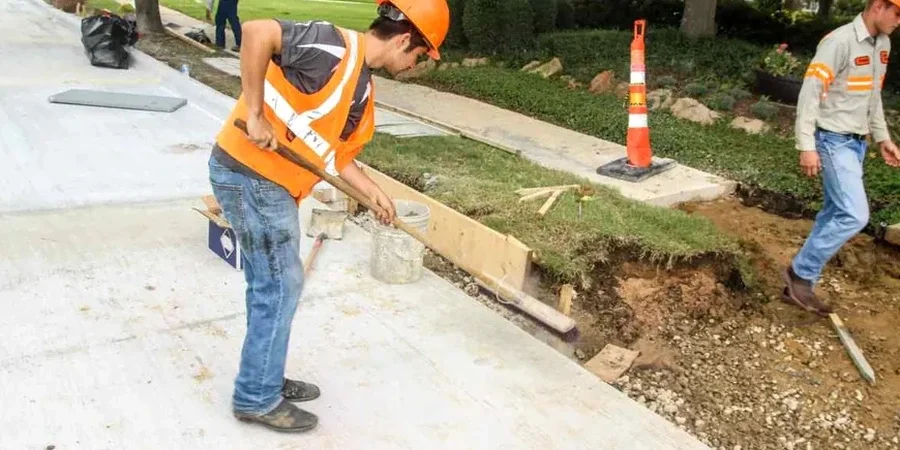
Site-specific factors
The subgrade conditions below a rigid pavement design in London Ontario can vary dramatically within a single site, a reality starkly visible when comparing the well-drained sandy loam near the Byron gravel pits against the heavy, lacustrine clays found along the Thames River floodplain in the Old South neighborhood. A contractor who assumes a uniform k-value across a site that straddles these geological boundaries risks severe corner cracking and faulting within the first five years of service. The primary threat in London Ontario is not heavy traffic loading but moisture-induced volumetric instability; the silty clay matrix of the regional till stratum can heave with forces exceeding 100 kPa if the pavement section lacks an adequate capillary break. Our rigid pavement design explicitly addresses this by specifying an open-graded drainage layer, preventing the saturated conditions that lead to pumping of fine subgrade material through transverse joints under repeated axle loads.
Reference standards
CSA A23.3 - Design of Concrete Structures, NBCC 2020 - National Building Code of Canada, OPSS 350 - Concrete Pavement Construction, ASTM C78 - Flexural Strength of Concrete, ASTM D1196 - Plate Load Test for Subgrade
Other technical services
Subgrade Characterization and k-Value Verification
Field plate load testing and laboratory CBR analysis on Shelby tube samples extracted from the London till, providing the verified modulus of subgrade reaction required for accurate Westergaard edge stress calculations in the rigid pavement design.
Jointing Plan and Load Transfer Design
Detailed dowel bar sizing and spacing according to ACPA guidelines, tailored to the specific axle load spectra of the fleet using the pavement, whether it is a distribution center in the London Innovation Park or a municipal transit lane.
Freeze-Thaw Resistant Concrete Mix Specification
Development of performance-based mix designs with a maximum water-cement ratio of 0.45 and a target air-void system with a spacing factor below 0.20 mm, ensuring durability through London Ontario's 100+ annual freeze-thaw cycles.
Typical parameters
Quick answers
How do you determine the required thickness for a rigid pavement design in London Ontario?
The thickness is determined using the ACPA StreetPave or PCA method, which relies on the modulus of subgrade reaction (k-value) obtained through field plate load tests, the 28-day flexural strength of the concrete, and the estimated truck traffic over the design life. We always verify the k-value on the actual prepared subgrade rather than relying solely on conservative lab correlations, which can overestimate the required slab thickness in London's stiff clay tills.
What is the typical cost range for a rigid pavement design report in the London area?
A complete rigid pavement design package, including subgrade investigation, plate load testing, and the structural design report, typically ranges from CA$2,400 to CA$8,980 depending on the project's square footage and traffic loading complexity. A small commercial parking lot will fall at the lower end, while a heavily loaded industrial crane pad requiring detailed jointing plans and phased construction drawings will approach the upper end of that range.
What makes London Ontario's subgrade particularly challenging for concrete pavements?
London Ontario sits on the Port Stanley Till, a silty clay deposit with high frost susceptibility. The challenge is not low bearing capacity but rather the volume change from seasonal moisture fluctuations. Without a properly designed granular subbase acting as a capillary break, the subgrade can heave unevenly, causing slab warping and cracking at the joints that greatly reduces the pavement's service life.