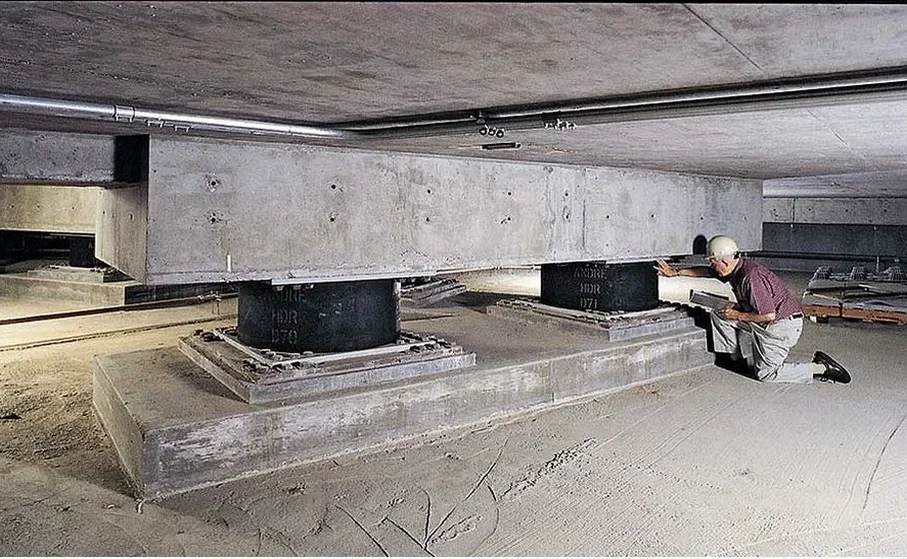
London, Ontario sits in a moderate seismic zone, but its deep glacial Lake Warren deposits create a specific amplification concern. The Silurian bedrock lies buried under 30 to 60 meters of stratified silty clay and till, a profile that can significantly lengthen ground motion periods in a seismic event. For essential facilities like hospitals or emergency operations centers, a rigid foundation approach often fails to meet post-disaster functionality targets. We integrate site-specific hazard deaggregation with seismic microzonation to define the controlling scenario, then design the isolation plane to shift the structure’s fundamental period away from the site’s predominant soil period. This decoupling strategy is particularly effective in the soft soils flanking the Thames River, where basin-edge effects can amplify long-period energy. The methodology is calibrated against the 2020 National Building Code of Canada (NBCC) and CSA A23.3, ensuring the isolator testing protocol matches the anticipated displacement demands derived from London’s uniform hazard spectra.
Decoupling a London structure from its clay-rich substrate is not just a structural choice; it is an operational continuity strategy mandated by post-disaster performance levels.
Our approach and scope
Site-specific factors
The geotechnical contrast between the Byron gravel terraces in the west and the Komoka clay plains to the east illustrates the isolation design challenge. In Byron, the dense till cap offers a firm bearing stratum, so isolators can be placed directly on reinforced concrete pedestals with minimal settlement concern. Move into the floodplain areas near Westminster Ponds, and the high-plasticity glaciolacustrine clays introduce a risk of seismic settlement beneath the isolation plane. A rigid foundation block on these soils might tilt slightly during a long-duration event, binding the moat wall and short-circuiting the isolation effect. To mitigate this, we often recommend a stone columns ground improvement program below the lower raft, densifying the soft clay to a target N60 of 12-15 blows and providing a drainage path for excess pore pressure. Without this dual-level approach, the isolation system’s theoretical 2.0-second period could degrade, pulling the structure back into the amplified response range of the London soil column.
Reference standards
NBCC 2020 (National Building Code of Canada, Part 4), CSA A23.3-19 (Design of Concrete Structures, Seismic Provisions), CSA S6:19 (Canadian Highway Bridge Design Code, Section 4), ASCE/SEI 7-22 (Referenced for isolator testing & acceptance criteria), ISO 22762 (Elastomeric seismic-protection isolators)
Other technical services
Nonlinear Time-History Analysis & Peer Review
We build and run 3D ETABS or Perform-3D models incorporating gap elements for the moat wall, velocity-dependent damping, and upper/lower bound isolator properties. The output includes story drift ratios, floor acceleration spectra for non-structural components, and the required moat cover detailing.
Prototype & Production Isolator Testing Oversight
We specify the testing protocol per CSA S6 and oversee the full-scale dynamic tests at an accredited Canadian lab. The report verifies the effective stiffness and equivalent viscous damping at the design displacement, confirming the three-cycle stability required for London’s post-disaster occupancy classification.
Typical parameters
Quick answers
What is the cost range for a base isolation design package for a London building?
For a medium-complexity institutional or healthcare project in London, the complete isolation design — including nonlinear time-history analysis, isolator specification, testing oversight, and peer review — typically falls between CA$5,370 and CA$12,830. The final fee depends on the number of isolator types, the extent of ground motion scaling required for the soil profile, and the review depth mandated by the authority having jurisdiction.
How does the NBCC 2020 address base isolation compared to fixed-base design?
The NBCC 2020 contains specific provisions in the structural commentaries for seismically isolated structures, permitting a reduction in the design base shear. It requires site-specific hazard analysis for sites like London with Class D or E profiles, and mandates that the isolation system be designed for a displacement demand corresponding to the 2% in 50-year probability, with upper-bound properties accounting for aging and temperature effects.
Can existing London buildings be retrofitted with base isolation?
Yes, but it is a complex undertaking on London’s soft soils. A retrofit requires lifting the entire structure to insert the isolation plane, which often necessitates extensive underpinning and temporary anchors to stabilize the existing foundations. We analyze the existing gravity-load system for the jacking forces and design a temporary lateral restraint scheme to maintain structural integrity during the installation sequence.